In my first post I called the telc B1 speaking exam the boss fight. That was June. It is now July, my exam is in August, and I can report that the boss fight has not gotten smaller by being ignored. Bosses never do.
So I did the thing I always do when a problem scares me: I turned it into numbers. For weeks my practice scores looked like a reliable, unmoving 60-ish percent on Einander kennenlernen (the introduction part), and a genuinely upsetting 47 percent on Gemeinsam etwas planen (the planning dialogue). Forty-seven. That's not a scoreline, that's a cry for help. And since you need 60 percent on the oral exam to pass it at all, one of those numbers was a fail, dressed up in practice-mode clothing.
As of this week: 80 percent on the introductions, 67 on the planning. Not heroic. But one of those parts went from "failing" to "passing with room to breathe," in about two weeks, and I can tell you exactly what changed, because I built the thing that changed it. Humble brag.
This post is three things: what actually happens in those 15 minutes (the part I couldn't find a straight answer to anywhere that wasn't a scanned PDF from 2019), why my scores were stuck, and the cheat sheet system that moved them...with the receipts.
What actually happens in the telc B1 speaking exam
Here's the spec, engineer to (possibly) engineer, because when I first looked for this I found mostly PDF fragments and vibes.
The oral exam (Mündliche Prüfung) is about 15 minutes, and you take it in a pair with another candidate and not alone across a desk from an examiner. Two examiners sit in, mostly listen, and occasionally ask a follow-up question. Before you go in, you get 20 minutes of preparation time with the task sheets, and you're allowed to make notes. You can glance at your notes in the exam; you probably should not read from them though.
The oral part is worth 75 of the exam's 300 total points, and here's the detail that changes how you should prepare: it's passed separately. You need 60 percent — 45 of 75 points — on the oral exam alone. A brilliant written exam cannot rescue a failed speaking exam. They don't average.
The 75 points split across three parts:
| Part | What it's called | Points | Time |
|---|---|---|---|
| Teil 1 | Einander kennenlernen | 15 | ~2.5 min |
| Teil 2 | Über ein Thema sprechen | 30 | ~5 min |
| Teil 3 | Gemeinsam etwas planen | 30 | ~5 min |
And the examiners grade you on four criteria: expression (Ausdrucksfähigkeit), task management (Aufgabenbewältigung), accuracy (Formale Richtigkeit), and pronunciation and intonation (Aussprache und Intonation).
Read that list again, because it contains the single most calming fact about this exam: though grammar is one criterion out of four, you do not lose the speaking exam by confusing der and dem. You lose it by going quiet, by not finishing the task, by leaving your partner hanging. B1 examiners expect mistakes. What they're actually checking is whether the conversation works.
Teil 1: Einander kennenlernen — the freest 15 points in the exam
The Teil 1 task sheet is the same in every telc B1 exam. Not similar. The same. Both candidates get a sheet that says, in effect, "get to know your partner" followed by the same five prompts every single time: your name, where you're from, how you live (family, house, apartment), what you do (work or studies), and which languages you speak, how long, and why.
It lasts about two and a half minutes and ends with the examiners asking you one or two extra questions about something you said.
This makes Teil 1 the only part of the entire speaking exam you can fully script at home. Which makes it slightly embarrassing that I was stuck at 60 percent on it. I knew myself. I have met me. I just couldn't say myself — I treated it as improv every single time, re-deriving from first principles how to explain my own job, and it came out as mush.
Teil 2: Über ein Thema sprechen — the structured one
In Teil 2, you and your partner each get a card with a short magazine-style text: a named person — name, age, job — giving their opinion on some topic. Your two texts always take different or opposing positions. Then the task runs in three fixed phases: you each report what's in your text (in your own words — reading it aloud is the classic beginner's own-goal), then you exchange opinions on the topic, then you connect it to your own experience.
The trap here isn't language, it's structure: people skip the reporting phase, or drown in it, or forget to actually ask their partner anything. If you know the three phases, the task carries you. This was my least-broken part, so I'll keep it short — but everything in the cheat sheet section below applies here too.
Teil 3: Gemeinsam etwas planen — where I was bleeding points
Teil 3 hands you and your partner one shared task sheet: a scenario ("You want to organize a film evening together…") plus a short list of open points — when exactly? food and drinks? costs? who invites whom? Unlike Teil 2 there are no cards, no positions, no report phase. The whole thing is a single live negotiation, and it's graded on interaction from the first sentence.
This is the part where my 116117 demon lives — if you read the first post, you know the one: real person, real time, no script, grammar engine seizes up. Making a suggestion, catching your partner's counter-suggestion, disagreeing politely, landing on a decision — all in real time — is the closest the exam gets to that phone call. Hence: 47 percent. In a real exam that single part would have been dragging me under the waterline.
Why my scores were stuck (it wasn't vocabulary)
Here's the diagnosis it took me too long to reach: my problem was never knowing German. Every word I needed in the planning dialogue, I knew. Sitting still, reading, I could produce textbook sentences. Under pressure, live, with a partner waiting — nothing. The knowledge was there; the retrieval was failing.
And then the reframe that changed my prep: the speaking exam is not an improv show. It's a play where you're allowed to write your own lines in advance. The scenarios change — film evening, farewell party, visiting a sick colleague — but the moves never do. You will always open, suggest, react, counter, and close. In Teil 1, even the topics are fixed. Something like 80 percent of every sentence you'll say is a reusable frame; only the slots change.
Which means the fix isn't "learn more German." The fix is: automate the frames, so your brain's entire live capacity goes into the slots.
My Mündlicher Ausdruck cheat sheet
This is the part where I get to plug the thing I built, because I built it out of exactly this desperation.
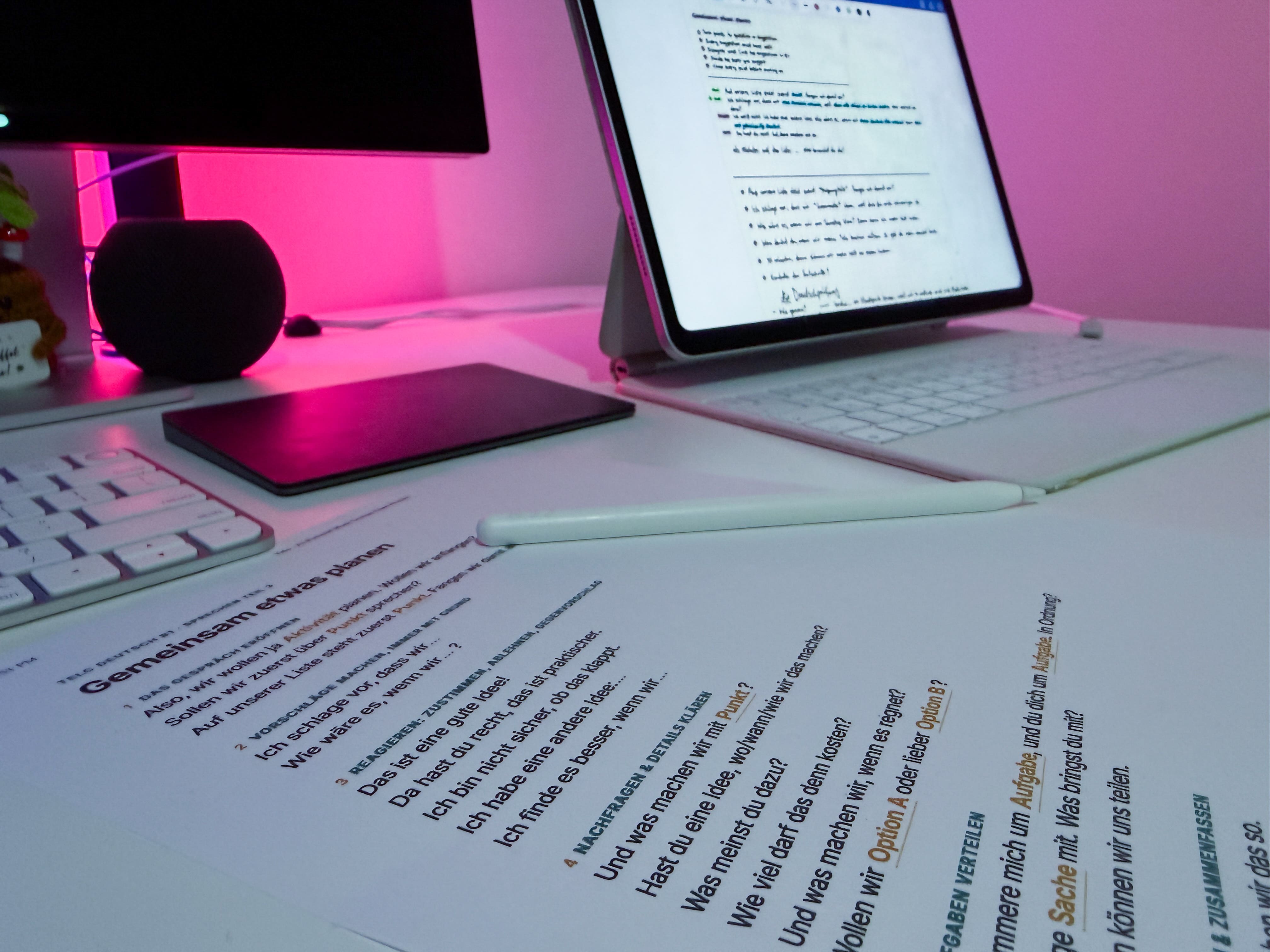
Yulo's strategy pages have a library of sentence stems (Redemittel) for each speaking part — each one topic-agnostic and checked against the official telc model tests, so they're frames that actually fit the exam, not phrasebook filler. But the feature that changed my numbers is dumber and better than that: you tick the stems you'd actually say and print them as a one-page cheat sheet. You have the fixed frame and marked gaps you fill live.
No, you can't bring it into the exam. The only cheat sheet you're allowed in the room is the one in your head. The printed page is how you write onto that one. My drill, roughly ten minutes a day:
- Read a stem, out loud, three times, with different slot content each time. "Ich schlage vor, dass wir am Samstag …" — "…dass wir bei mir …" — "…dass wir zusammen kochen."
- Cover the sheet. Say the move from memory with a fresh slot.
- Run a practice dialogue with the sheet next to me — allowed to glance, not allowed to read.
- After a few days: same dialogue, sheet face-down. It turns out if you've said "Wie wäre es, wenn wir…" forty times, it stops being grammar and starts being a reflex. Reflexes don't seize up.
The point of picking your own stems matters more than it sounds. A cheat sheet of somebody else's favorite phrases is a script; a cheat sheet of your phrases is just you, pre-compiled.
The receipts
I promised numbers, so: numbers.
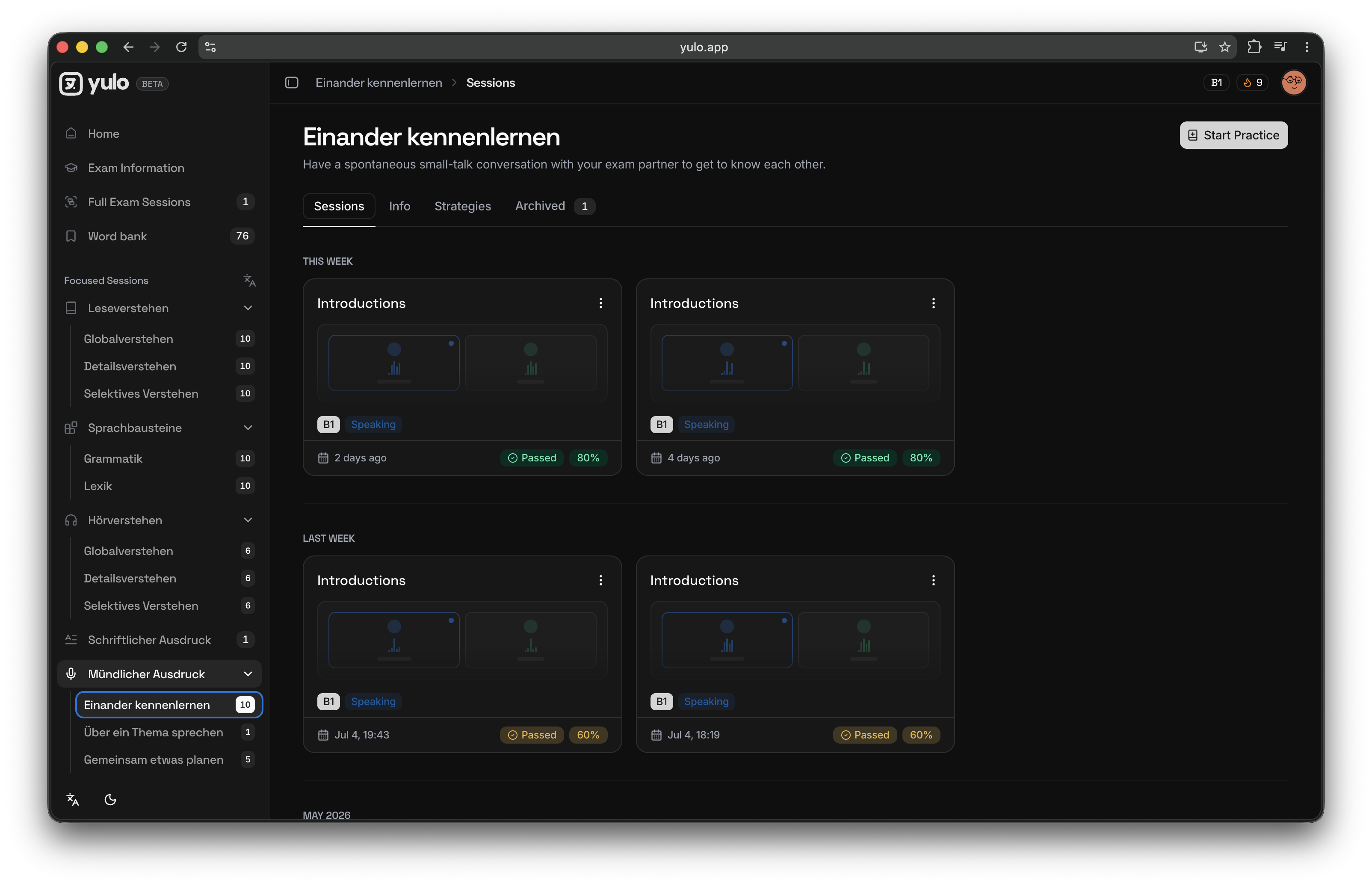
Einander kennenlernen: weeks of 60-ish percent, then a climb to 80 percent once I stopped improvising my own biography and drilled a scripted core.
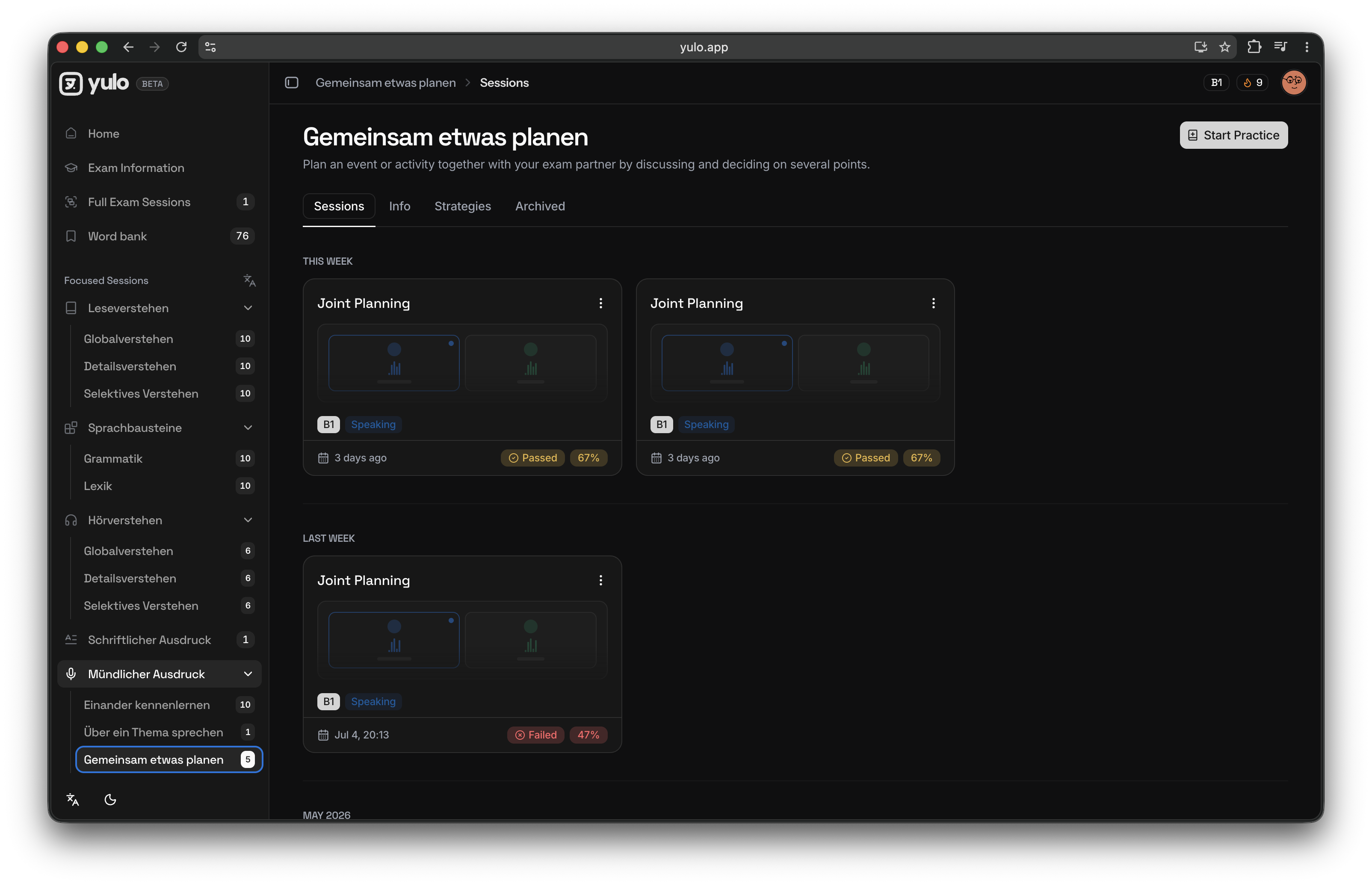
Gemeinsam etwas planen: from 47 percent — a failing score — to 67, which is on the right side of the 60-percent pass line with a little air beneath it.
Honesty section, because the internet has enough miracle graphs: these are scores from Yulo's AI-graded practice sessions, not from certified telc examiners, and 67 percent is "passing," not "safe." I'd like more margin before August. But the shape of the change is the point — the number that moved wasn't my German level. Two weeks isn't enough time to meaningfully improve at German. It's plenty of time to stop wasting the German you have on sentence scaffolding.
The stems that do the heaviest lifting
Here's a slice of my actual cheat sheet. The bold part is fixed — drill it until it's a reflex. The bracketed slots are what you fill live.
Teil 1 — the scripted biography:
- Ich heiße … und komme ursprünglich aus [Land/Stadt].
- Ich wohne seit [Zeit] in [Stadt], zusammen mit [Familie/Partner/allein].
- Von Beruf bin ich [Beruf] — ich arbeite als [Rolle] bei [Firma].
- Ich lerne Deutsch seit [Zeit], weil [Grund].
- For the examiner's surprise question: Das ist eine gute Frage — ich würde sagen, [Antwort]. (Buys you two full seconds. Two seconds is a lot.)
Teil 2 — the three phases:
- In meinem Text geht es um [Thema].
- [Name], [Alter] Jahre alt, ist [Beruf] und meint, dass [Position].
- Ich sehe das ähnlich / ganz anders, weil [Grund].
- Und wie ist das bei dir? (The interaction criterion, in six words.)
Teil 3 — the negotiation arc:
- Open: Also, wir wollen zusammen [Vorhaben] organisieren. Fangen wir mit [Punkt] an?
- Suggest: Ich schlage vor, dass wir [Idee]. / Wie wäre es, wenn wir [Idee]?
- React: Das ist eine gute Idee, aber [Einwand]. / Einverstanden! Und was machen wir mit [nächster Punkt]?
- Counter: Ich weiß nicht, ob das klappt. Vielleicht könnten wir stattdessen [Alternative].
- Close: Also gut, dann machen wir es so: [Zusammenfassung]. (Examiners love a landed decision. It's Aufgabenbewältigung in one sentence.)
Don't memorize all of them. Pick two per move — the ones you'd plausibly say at a kitchen table — and drill those until they bore you. Boredom is the goal state. Bored is what fluent feels like from the inside.
The mistakes the drilling quietly fixed
Looking at my old practice feedback, the points I was losing were almost never exotic:
- Monologuing in a dialogue task. Teil 3 grades interaction. A perfect uninterrupted paragraph is worth less than a messy exchange with real back-and-forth. "Was meinst du?" is free points, every time.
- Restarting sentences to repair small errors. I'd bail out of a sentence halfway to fix an article. The criteria reward flow; B1 tolerates wrong articles. Finish the sentence. Fix nothing.
- Ignoring the open-points list in Teil 3. That list isn't decoration — it's the task checklist the examiners are scoring against. Work through it and you've completed the task by definition.
- Treating Teil 1 as improv. Same five topics. Every exam. Script it, drill it, collect the 15 points.
The facts, in case you scrolled
- How long is the telc B1 speaking exam? About 15 minutes, plus 20 minutes of preparation time with notes allowed.
- Is it one-on-one? No — you're paired with another candidate; two examiners observe.
- How many points? 75, split 15 / 30 / 30 across the three parts. You need 45 (60%) to pass the oral exam — independently of the written exam.
- What are the three parts? Einander kennenlernen (introductions), Über ein Thema sprechen (topic discussion), Gemeinsam etwas planen (planning together).
- Can you prepare Teil 1 in advance? Completely. The task sheet is identical in every exam: name, origin, living situation, work, languages.
Where this leaves me
Exam's in August. One part of the boss fight has gone from "failing" to "passing," one from "meh" to "actually fine," and I have a one-page piece of paper to thank for most of it. I'll write the next post after the exam — either a victory lap or a very educational autopsy. Both make good content, only one makes a good citizenship application.
If your own speaking exam is looming: the strategy pages and cheat sheet builder are on Yulo, next to the AI speaking simulations I've been getting these scores from. Build the sheet, drill the stems, and go collect your free 15 points in Teil 1.
Wish me luck. Or don't, I have a cheat sheet now 😄.