A few weeks ago I came off my eBike and fractured the radial head in my elbow (a small bone you never think about until it's broken). So I needed to call 116117, Germany's medical on-call line, the number you ring when something's wrong but it's not 112-level wrong. I know how to do this in German. I've lived in Hamburg long enough. I can read a rental contract and roughly understand which rights I'm signing away. But the moment someone picked up, in German, because 116117 is German only and there is no friendly "for English, press two," something in my head quietly unplugged itself.
What came out wasn't German. It wasn't English either. It was that mangled in-between the Germans actually have a word for, Denglisch, except mine was the panic edition: a slurry of half-finished sentences, articles chosen by coin flip, and the word genau deployed every four seconds like a nervous tic. I knew the words. I'd known them an hour earlier. But under pressure, with a real person waiting on the line, the whole grammar engine seized up, and the only complete sentence I could produce was the most useless one available to me: „Mein Deutsch ist nicht gut."
In the end a friend made the call for me. Like a coward. A grown, bilingual coward who needed someone else to dial a health hotline on his behalf.
That phone call is a decent summary of where I am with German. On paper I'm somewhere between A2 and B1. In real life I get by fine, mostly because Hamburg runs on English and my work is entirely in English, so I've never been forced into the deep end. I can survive. I just can't perform. And a language exam is pure performance.
So here's the embarrassing part
This is the section where a normal blog post tells you how I passed the telc B1 and what you should learn from my triumph.
I haven't passed it. I haven't even taken it yet. I'm booked for August, which at the time of writing is about two months away, and I am writing this as a person who is actively avoiding studying for it right now by writing this instead.
I'm telling you that up front because the entire reason this blog exists is that I'm building a telc B1 prep app (it's called Yulo) while I'm still on the wrong side of the exam myself. I'm not the guru on the mountain. I'm the guy halfway up it, narrating the climb, occasionally slipping.
If that sounds like a strange person to take exam advice from, fair. But I'd argue it's the opposite. Most prep content is written by people who passed years ago and have forgotten what it actually feels like to freeze at a front desk. I haven't forgotten. I'm living it.
Why I'm Taking the telc B1 for Citizenship (and Why Now)
I'm in Germany for the long haul, and at some point "I'll get serious about German eventually" stops being a plan and becomes a thing you say to avoid having one. Live here long enough and it's pretty clear the language isn't optional forever. Sooner or later daily life corners you into it (see: the phone call above). The exam is just me deciding to stop letting it wait.
Citizenship is part of it, honestly. B1 is the German level you need to apply for naturalization, and once you've accepted you're staying, putting the language off starts to feel a little silly. But it's not only about a certificate. I'd want to actually speak the language of the place I live regardless. The exam is just the forcing function, the deadline that turns "someday" into "August."
I went back and forth between the telc B1 and the Goethe-Zertifikat B1, which both certify the same CEFR level and are both accepted for citizenship. I landed on telc B1 for fairly boring practical reasons: dates and test centres were easy to find near me in Hamburg, and the format felt a touch more straightforward to drill for. If you're stuck on telc vs Goethe at B1, that's honestly most of the decision. Pick the one you can actually book. For what it's worth, I've also heard telc runs a smidge more straightforward, though I'll reserve judgement until I've actually survived one.
That reframe helped, oddly. I'm not studying to become eloquent. I'm studying to clear a specific, scoreable bar, which, it turns out, is a far more tractable problem than "get good at German."
telc B1 Exam Format: What's Actually on the Test (and How It's Scored)
If you're like me, you've been vaguely afraid of this exam without actually knowing what's in it. So here's the spec, engineer to engineer.
The telc B1 comes in two separate parts, scored independently:
- A written exam, about 150 minutes, split into four sections: Leseverstehen (reading), Sprachbausteine (grammar and structure, basically fill-in-the-blank), Hörverstehen (listening), and Schriftlicher Ausdruck (writing, usually a letter or email).
- An oral exam, around 15 minutes, done in a pair with another candidate, not one-on-one with an examiner. You introduce yourselves, discuss a topic, and plan something together.
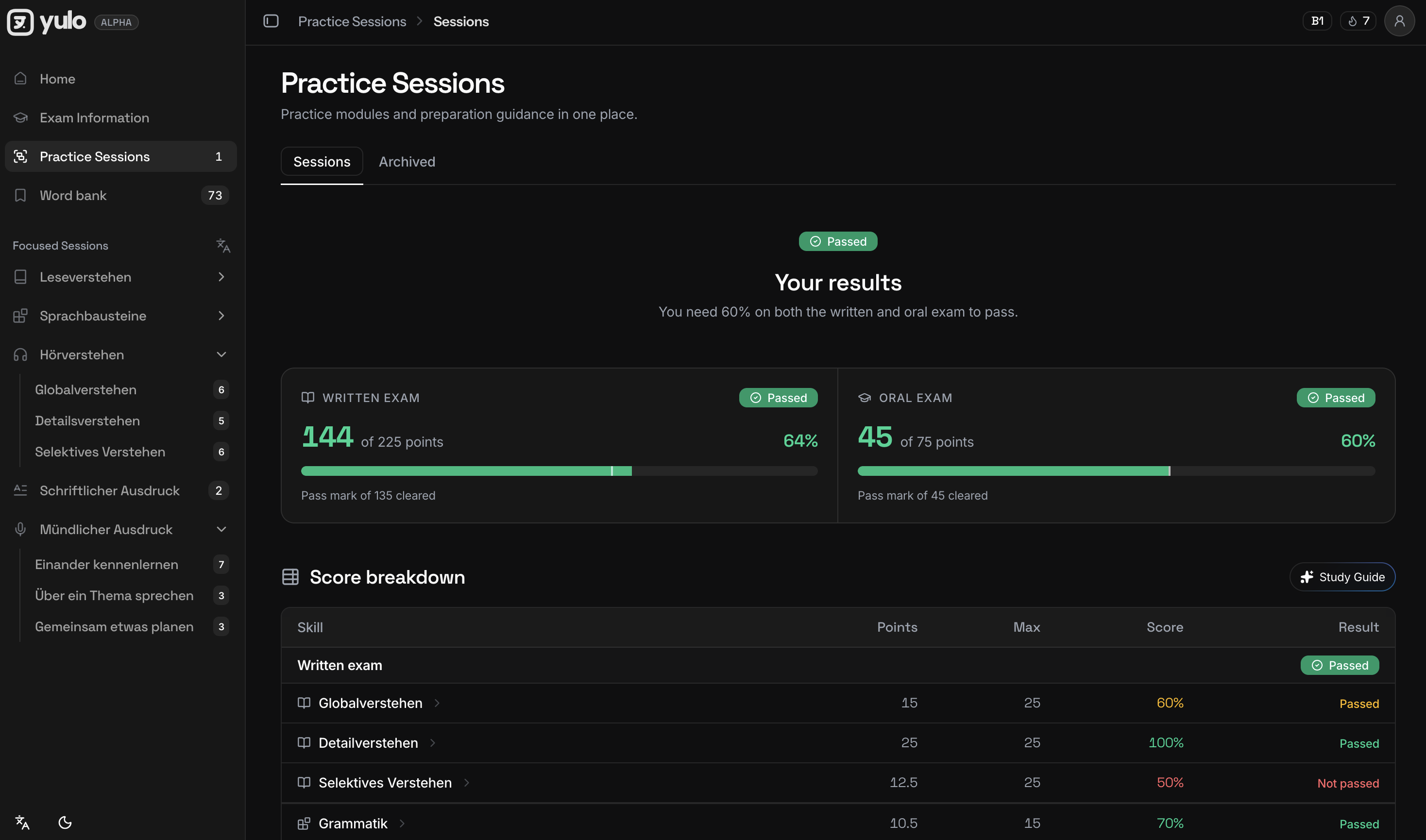
The whole thing is scored out of 300 points, and you need roughly 60% to pass, about 180 points. The catch that surprised me: the written and oral parts are graded separately, and you have to hit ~60% in each one independently. You can't ace the writing and coast through the speaking. They don't average out.
The good news hiding in that math: you do not need to be perfect. You can make a genuinely embarrassing number of mistakes and still pass. For a perfectionist who is not remotely in recovery, that's the most calming sentence in this entire post.
The telc B1 Speaking Section Is the Boss Fight
You can probably guess which of those parts keeps me up at night. The oral exam.
Reading and listening I can grind. Writing I can template. But speaking is where that 116117 demon lives. I'm not afraid of making mistakes exactly. I'm shy about them, which is a slightly different and more annoying thing. Fear you can push through with adrenaline. Shyness just quietly talks you out of opening your mouth. Add fast native speech and a stranger staring at you, and my fluency drops by about a level and a half in real time.
The thing I'm slowly making peace with: the telc B1 oral exam isn't a conversation, it's a performance with a rubric. The examiners aren't waiting for elegance. They want to see that you can make contact, exchange opinions, and plan something, even with mistakes, a wrong article here and there, a genau or two. That's a much smaller, more rehearsable target than "speak German well," which is the impossible standard I'd been quietly holding myself to.
Why I'm building an app instead of just, you know, studying
Here's the honest reason Yulo exists, and it's not a noble one.
I have terrible motivation for studying. I've taken plenty of language classes in my life and I know the drill, and I know that exam prep is its own separate, joyless skill on top of actually knowing the language. I do not enjoy it. I will avoid it with impressive creativity.
But I'm a software engineer, and there's one thing I'll happily do for twelve hours straight: build software. So I did the only logical thing for a person with my specific flavor of broken brain. I bolted the thing I hate (studying for a language exam) onto the thing I love (writing code). If I build the prep tool, I have to understand the exam deeply enough to model it. I have to break the telc B1 down into its parts, design the question types, think about scoring, invent the strategies. I end up studying by accident, through the back door, while telling myself I'm just shipping features.
It's a hack. It's me tricking myself into preparing. And the funny part is it's working better than any study plan I've ever abandoned in week two.
What happens next
August is coming whether I'm ready or not. Between now and then I'm going to keep building Yulo, keep documenting what I learn about the telc B1 as I learn it, and, at some point, actually call 116117 myself, in German, and stay on the line instead of outsourcing it to a friend.
If you're also somewhere on the A2–B1 slope, also putting off an exam you've decided matters, also a little tired of advice from people who've forgotten what struggling feels like, then follow along with this one. I'll share what's working and what isn't as I prep, in real time, with no pretending I've got it all figured out.
I'll let you know how August goes. Best case, I pass and this turns into a slightly smug success story. Worst case splits two ways: I coward out and postpone again, or I actually show up and fail, in which case you get your cautionary tale. Either way, you'll hear about it here.
telc B1 FAQ
What level is the telc B1 exam?
It certifies B1 on the CEFR scale: the level where you can handle most everyday situations in German, and the standard language requirement for German citizenship.
How is the telc B1 structured?
Two parts: a ~150-minute written exam (reading, grammar/Sprachbausteine, listening, and writing) and a ~15-minute oral exam done with a partner.
What score do you need to pass the telc B1?
Around 60%. The exam is out of 300 points (roughly 180 to pass), and you must reach ~60% in the written and oral parts separately. The two scores aren't combined.
telc B1 or Goethe B1: which should I take?
Both certify the same B1 level and are both accepted for citizenship, so it usually comes down to logistics: which exam has dates and test centres near you, and which format you'd rather prepare for. I went with telc B1 because it was easier to book in Hamburg.
Do I need the telc B1 for German citizenship?
B1 is the standard German language level required for naturalization, and the telc B1 (Zertifikat Deutsch) is one of the commonly accepted certificates that prove it. Always check the current requirements with your local authority.
What's the hardest part of the telc B1?
For a lot of people, me included, it's the speaking section, because it happens live and under pressure. The reassuring news is that it's scored against a rubric, not against fluency, and you don't need a perfect performance to pass.