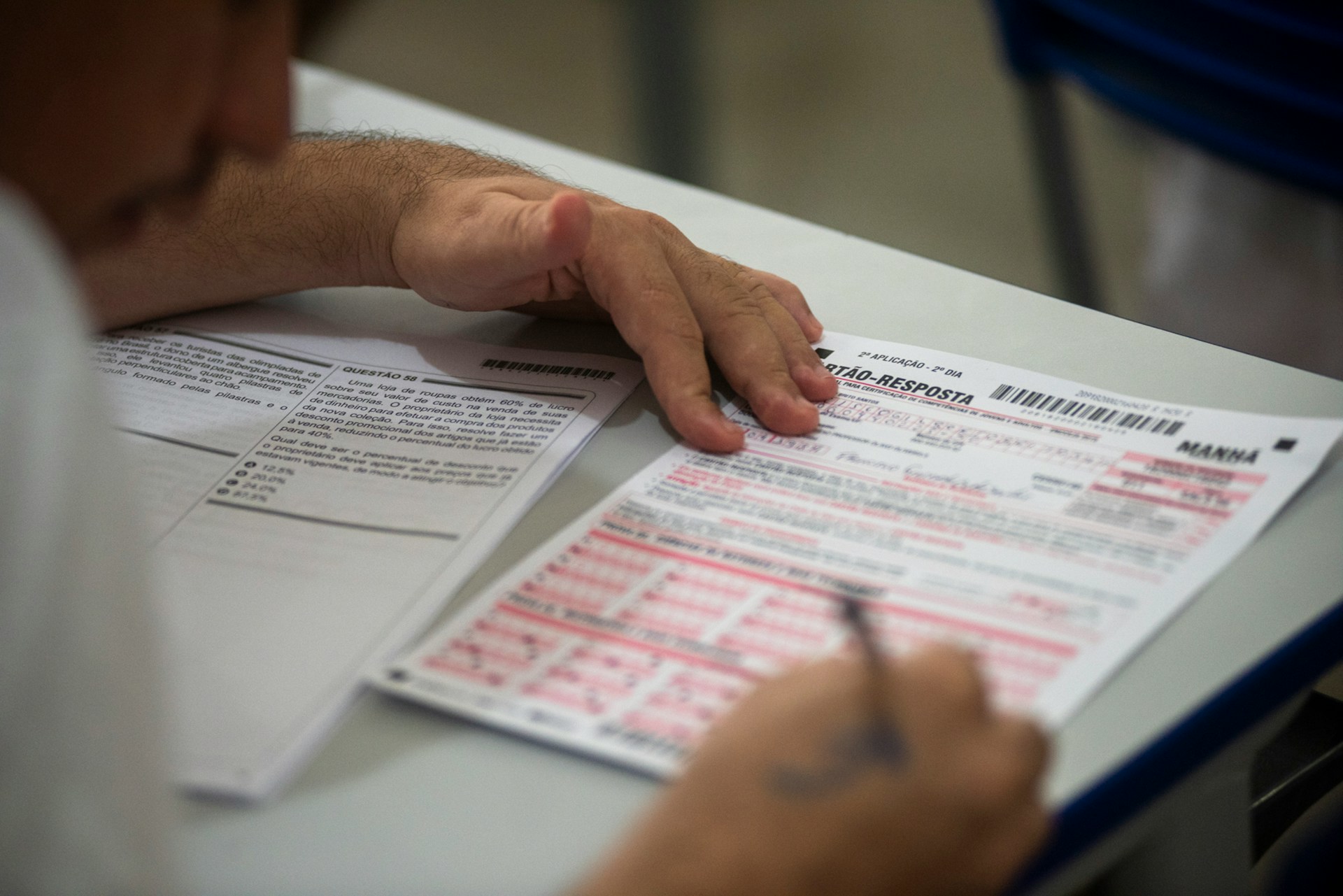
If you need to prove German at B1 level for citizenship (Einbürgerung) or permanent residence (Niederlassungserlaubnis), you will almost certainly choose between two exams: the Deutsch-Test für Zuwanderer (DTZ) and telc Deutsch B1 (Zertifikat Deutsch). Both are recognized. The choice still matters, because the exams differ fundamentally in one respect: what happens when your result falls just short.
The short answer
- You are taking an integration course (or are entitled to one)? Take the DTZ. It is the official final exam, free for course participants, and if you miss B1 you still walk away with an A2 certificate.
- You need a B1 certificate quickly, without a course? Take telc B1. More dates, more test centers, a clean pass or fail.
For everyone who wants the details: here they are.
Side by side
| DTZ | telc Deutsch B1 | |
|---|---|---|
| Operator | BAMF (state), developed by telc and Goethe-Institut | telc gGmbH (private) |
| Level | scaled: A2 or B1 | B1 only: pass or fail |
| Written | approx. 100 minutes (listening, reading, short letter) | approx. 150 minutes (Leseverstehen, Sprachbausteine, Hörverstehen, letter) |
| Oral | approx. 15 minutes, in pairs | approx. 15 minutes, in pairs |
| Result | per skill: listening/reading, writing, speaking, each A2 or B1 | overall score out of 300, 60% needed in written and oral separately |
| Topics | everyday life in Germany: authorities, work, doctor, housing | general German |
| Cost | free within the integration course, self-payers approx. 130 to 180 euros | approx. 150 to 230 euros depending on the center |
| Dates | tied to integration course providers, often at course end | many centers, often monthly or more |
The most important difference: result logic
telc B1 is all or nothing. You need 60 percent in the written part (135 of 225 points) and 60 percent in the oral part (45 of 75). Miss either threshold and the exam is failed; there is no lower-level certificate as a consolation.
The DTZ has a safety net, with a catch. The certificate reports each skill separately: listening/reading (combined), writing, and speaking, each as A2 or B1. You get the overall result B1 if you reach B1 in speaking plus B1 in at least one of the other two parts. If you fall short, you still hold an A2 certificate.
The catch: for citizenship and permanent residence, the DTZ only counts with the overall result B1. The A2 safety net feels reassuring but does not move you forward for those purposes.
For citizenship: what actually matters
Naturalization requires sufficient German, which means B1 (as of 2026, standard track after 5 years of residence; rules change, so confirm with your naturalization office). Recognized proofs include:
- the DTZ certificate with overall result B1
- the telc Deutsch B1 certificate (Zertifikat Deutsch)
- the integration course certificate ("Zertifikat Integrationskurs")
A detail almost no comparison mentions: the integration course final exam includes, besides the DTZ, the "Leben in Deutschland" test (33 questions). 15 correct answers pass it for the course, and from 17 correct answers it simultaneously counts as the citizenship test (Einbürgerungstest). Completing the integration course therefore often covers both citizenship requirements (language and civic knowledge) in one go. With telc B1 alone, you still need to take the citizenship test separately.
More on this: telc B1 for naturalization.
Which exam is easier?
Honest answer: they are hard in different ways.
- Topics: The DTZ stays inside German daily life (appointments, forms, work, housing). If you have lived in Germany for a few years, you know these situations. telc B1 is thematically broader.
- Writing: The DTZ letter is shorter and closer to real life. The telc B1 letter has four Leitpunkte and a grading rule that can zero out an entire letter when at most one Leitpunkt is addressed. How it works: our article on the zero rule.
- Sprachbausteine: Only telc B1 has an explicit grammar and vocabulary section. The hardest part for some, the most predictable for the well-prepared.
- Duration: At around 100 written minutes, the DTZ is considerably shorter than telc B1 at roughly 150.
Decision guide
Take the DTZ if you:
- are taking (or can take) an integration course, where the exam and preparation are included
- want a documented result even below B1
- are more comfortable with everyday German topics than general ones
Take telc B1 if you:
- are not doing an integration course and simply need a date soon
- want a classic B1 certificate that reads as B1 without extra conditions
- are already training specifically for the four telc sections
FAQ
Is telc B1 accepted for German citizenship?
Yes. The telc Deutsch B1 certificate is recognized as proof of sufficient language skills. It does not replace the citizenship test.
Is a DTZ certificate with A2 enough for citizenship?
No. Only the overall result B1 counts for citizenship and permanent residence.
Can I take the DTZ without an integration course?
Yes, as a self-payer at licensed providers. It is only free as part of the integration course.
When do I get the overall result B1 in the DTZ?
When you reach B1 in speaking and B1 in at least one other part (listening/reading or writing).
Can I retake telc B1?
Yes, as often as you like. Registration and fees go through the test center.
Whichever exam you pick: B1 has to be solid
Both exams test the same skills at the same level. With Yulo you practice every telc B1 section interactively, from Hörverstehen to the letter graded against the real criteria, and always see where you stand.